





Pure Molybdenum vs. TZM Tube: How Big Is the Difference in High-Temperature Performance?
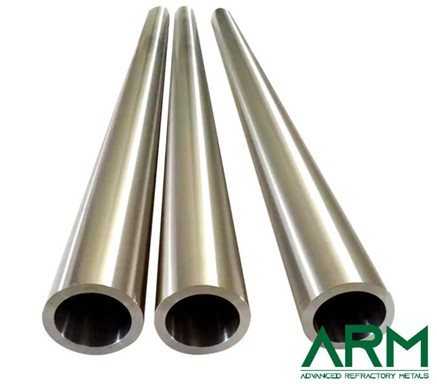
In the world of high-temperature structural materials, pure molybdenum and TZM (titanium-zirconium-molybdenum alloy) are often compared. A lot of people ask: they look pretty similar, but TZM costs noticeably more—so when it comes to high-temperature performance, how big is the difference really?
The short answer: it's huge. And that difference gets bigger as temperatures rise and service time stretches out.
1. The Biggest Difference: Recrystallization Temperature
Recrystallization temperature is the key metric for high-temperature performance in molybdenum-based materials. Once you hit this temperature, the grains inside the material start to rearrange and grow, causing a sharp drop in strength and making the material brittle. That's the #1 reason pure molybdenum tubes fail in high-temperature applications.
- Pure molybdenum recrystallization temperature: about 900–1100°C
- TZM recrystallization temperature: about 1350–1400°C
TZM's recrystallization starts at 1350°C and finishes at 1700°C. That's a bump of 500°C and 450°C, respectively, compared to pure molybdenum. What does that mean? At temperatures above 1000°C, pure molybdenum may already be starting to break down structurally, while TZM is still going strong.
Why can TZM do that? The added titanium (~0.5%), zirconium (~0.08%), and carbon form tiny, evenly distributed carbide particles (TiC, ZrC). These nano-sized particles act like a bunch of "micro-rivets" pinning down the grain boundaries, effectively stopping grains from moving and growing.
Bottom line: On recrystallization temperature—the most critical measure—TZM beats pure molybdenum by about 300–500°C. That's a massive gap.
2. High-Temperature Strength: The Gap Widens as Temperatures Climb
At 1000°C, the strength difference is already dramatic.
|
Property |
Pure Mo |
TZM |
Difference |
|
Tensile strength at 1000°C |
150–200 MPa |
350–450 MPa |
TZM is about 2x stronger |
|
Tensile strength at 1200°C |
Drops sharply |
150–200 MPa |
TZM still holds useful strength |
As the table shows, at 1000°C, TZM's tensile strength is more than double that of pure molybdenum. That means under the same high-temperature load, a pure molybdenum tube could deform significantly or even fail, while a TZM tube keeps its structural integrity.
Also, TZM's creep resistance is significantly better than pure molybdenum. Creep is that slow, time-dependent plastic deformation that happens when a material is under constant high temperature and stress. For parts that need to operate at high temperatures for long periods (like heating furnace supports or heat pipes), creep resistance directly determines service life.
Bottom line: TZM beats pure molybdenum across the board on high-temperature strength and creep resistance. The gap is substantial.
3. Thermal Conductivity & Thermal Expansion: Not Much Difference
These are the "tie" categories—not much difference.
- Thermal conductivity: Pure molybdenum ~138 W/m·K; TZM ~120–140 W/m·K. Pure molybdenum is slightly higher, but the gap is within 10–15%. For most real-world applications, that's totally acceptable.
- Coefficient of thermal expansion: Pure molybdenum ~5.1×10⁻⁶/K; TZM ~4.8–5.5×10⁻⁶/K. They're nearly identical. That means when you're pairing them with other materials (like ceramics or heat-resistant steels), they're equally well-matched.
Bottom line: On heat transfer and thermal expansion matching, these two are pretty close.
4. Cost: TZM's Weak Spot
Cost is always a factor in engineering decisions.
Pure molybdenum has a relatively mature production process and lower cost, making it a good fit for low-to-medium temperature or non-critical applications where you need large quantities. TZM, on the other hand, requires added alloying elements (titanium, zirconium) and tighter control over the powder metallurgy or melting process, so its cost is significantly higher.
5. Quick Comparison Table
|
Aspect |
Pure Molybdenum |
TZM |
|
Recrystallization temperature |
900–1100°C |
1350–1400°C |
|
Tensile strength at 1000°C |
150–200 MPa |
350–450 MPa |
|
Creep resistance |
Moderate |
High |
|
Thermal conductivity |
~138 W/m·K |
120–140 W/m·K |
|
CTE |
~5.1×10⁻⁶/K |
~4.8–5.5×10⁻⁶/K |
|
Cost |
Lower |
Higher |
Material Selection
Back to the original question: in the most important temperature-related properties, is the difference between pure molybdenum and TZM tubes really that big?
Yes—absolutely. Especially on the key measure that determines how long a material will last at high temperatures.
- If your application is low-to-medium temperature (below 1000°C), short cycles, or cost is a major concern: pure molybdenum tubes are a solid, economical choice. Examples: some medium-temperature industrial furnace supports, electrodes, etc.
- If your application is high temperature (above 1100°C), long service life, or significant mechanical stress: TZM tubes are the irreplaceable choice. Examples: seamless steel pipe piercing mandrels, aerospace nozzles, nuclear reactor heat pipes, high-temperature molds, etc.
Advanced Refractory Metals (ARM) offers molybdenum tubes and molybdenum alloy tubes, including TZM tubes and La₂O₃-doped molybdenum (Mo-La) tubes.
REVIEWS
{{viewsNumber}}
Thought On "{{blogTitle}}"

{{item.name}}
{{item.created_at}}
{{item.content}}
LEVE A REPLY
Comment
Name
*
Email
*
{{item.children[0].name}}
{{item.children[0].created_at}}
{{item.children[0].content}}
{{item.name}}
{{item.created_at}}
{{item.content}}
More Replies
LEAVE A REPLY
Comment
*
Name
*
Email
*
SUBSCRIBE OUR NEWSLETTER
Your Name
*
Your Email
*
Success ! You're now subscribed
You've been successfully subscribed! Check your inbox soon for great emails from this sender.
Our Latest News
Tel : (949) 407-8904
Address : 1940 East Deere Avenue, Suite 100, Santa Ana, CA 92705, U. S. A
Metals

Useful Links
Featured Posts