





How to Choose from Different Molybdenum Crucibles
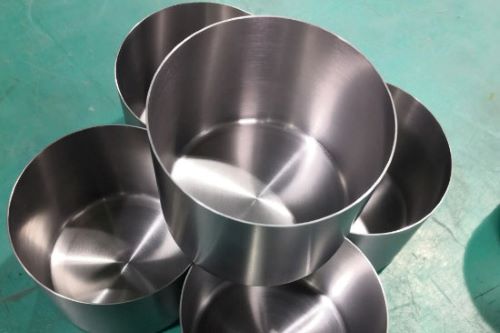
Molybdenum, with its high melting point of 2,623°C, excellent thermal conductivity, and robust high-temperature strength, has emerged as a go-to material for crucibles. However, not all molybdenum crucibles are identical. Depending on the production method, coating, geometry, and application, these crucibles vary significantly.
1. By Manufacturing Method
The method by which a molybdenum crucible is produced directly impacts its properties, such as density, porosity, cost, and performance.
A. Powder Metallurgy (PM) / Sintered Molybdenum Crucibles
In this method, molybdenum powder is compacted and then sintered at temperatures up to 2,000°C in a hydrogen atmosphere to create a solid form. Sintered molybdenum crucibles are ideal for general laboratory applications, such as melting non-reactive metals like certain rare earth elements. They are also well-suited for sintering atmospheres where some degree of permeability is acceptable.
Key Characteristics include:
- Cost-Effective: Sintered crucibles are generally cheaper to produce, making them an attractive option for standard applications.
- Porosity: While typically offering high sintering density (above 97% theoretical), some porosity remains, which may limit their use in reactive environments.
- Grain Structure: The resulting crucible tends to have a fine-grained and isotropic structure.
- Shape Limitations: Most sintered crucibles are limited to simple geometric shapes like cylinders or cups. Complex shapes can be challenging and costly to produce.
B. Machined (Wrought) Molybdenum Crucibles
Wrought molybdenum crucibles are crafted by machining solid bars, plates, or sheets of molybdenum. These are forged, rolled, and then precisely machined into the desired shape. Wrought molybdenum crucibles are best suited for high-purity applications, including semiconductor crystal growth (such as silicon and GaAs), optical glass melting, and high-purity metal refining. They are also ideal for the melting of reactive metals, such as titanium and zirconium alloys, where any contamination from porosity would be unacceptable.
Key Characteristics are:
- Superior Density & Impermeability: Wrought crucibles are 100% dense, with no porosity, which makes them ideal for high-purity and reactive metal applications.
- Excellent Surface Finish: The machining process creates smooth, polished interiors, which reduces nucleation sites and improves the release of molten materials.
- High Cost & Material Waste: The machining process generates significant material waste, which increases production costs.
- Grain Flow: The microstructure from forging and rolling gives wrought molybdenum crucibles superior directional strength.
C. Welded / Fabricated Crucibles
Molybdenum components are cut and welded together using processes like TIG (Tungsten Inert Gas) welding or electron beam welding to create crucibles of larger and more complex shapes. Welded molybdenum crucibles are best suited for industrial-scale processes, such as those involving continuous sintering belts or custom furnace liners. They are also ideal for custom applications where the geometry of the crucible needs to be specifically tailored to meet the requirements of the process.
Key Characteristics involve:
- Large & Complex Geometries: This method enables the fabrication of larger crucibles and more intricate shapes that are impossible to achieve with other methods, such as rectangular trays or large custom receivers.
- Weld Seam Integrity: The welds can be weak points and potential sources of contamination, so high-quality welding is critical.
- Cost for Size: Larger crucibles are often more cost-effective when welded compared to machining from solid material.
2. By Coating and Surface Treatment
Molybdenum is prone to oxidation at high temperatures (over 600°C), so coatings are commonly applied to extend its operational lifespan and improve performance.
- Uncoated (Bare) Molybdenum:
Used exclusively in vacuum environments or in controlled inert or reducing atmospheres (e.g., hydrogen, argon). - Silicide-Coated (MoSi₂):
The most widely used coating, MoSi₂ forms a self-healing SiO₂ layer at high temperatures, offering excellent oxidation resistance in air up to 1,700°C. - Ceramic Coatings (YSZ, Alumina):
These ceramic coatings are used for specific chemical compatibility, preventing reactions with certain melts, such as oxide melts in crystal growth. - Platinum or Rhodium Plating:
Applied in highly corrosive applications, like glass melting, to prevent molybdenum from reducing ions in the melt and causing discoloration.
3. By Geometry and Application-Specific Design
The shape and geometry of a molybdenum crucible are often designed to suit specific industrial processes, and these designs ensure optimal performance in various environments.
- Standard Cylindrical Crucibles:
These are the most common shape, used in vacuum induction melting (VIM), arc melting, and general laboratory furnaces. - Boat Crucibles (Rectangular/Trough):
Open-topped vessels for sintering, annealing, or zone refining. These are often fabricated or machined. - Conical or Tapered Crucibles:
These crucibles are designed to facilitate pouring or removal of solidified ingots, often used in bottom-pour VIM furnaces. - Susceptor Crucibles:
Specially designed for use in RF-heated furnaces such as Czochralski and Bridgman systems, where the molybdenum crucible itself is inductively heated. - Multi-Chamber / Segmented Crucibles:
These are used for gradient freeze or multi-sample experiments, often in high-throughput labs. - Specialty Crucibles for Crystal Growth:
- CZ Crucibles (Czochralski):
Large, bowl-shaped crucibles for semiconductor (e.g., GaAs, InP) or oxide crystals like sapphire. - VB/GF Crucibles (Vertical Bridgman/Gradient Freeze):
These elongated, often pointed crucibles are used for growing compound semiconductor ingots.
- CZ Crucibles (Czochralski):
4. How to Choose Your Molybdenum Crucible
Here's a handy selection matrix to guide your choice of crucible based on your process needs:
|
Primary Process Need |
Recommended Type |
Why |
|
Ultimate Purity / Reactive Metals |
Machined (Wrought) |
Zero porosity prevents infiltration and contamination. |
|
Oxidizing Atmosphere (>600°C) |
Silicide-Coated (MoSi₂) |
Provides essential oxidation protection in air atmospheres. |
|
Cost-Sensitive, Inert/Reducing Atmosphere |
Sintered (PM) |
Cost-effective for non-reactive or mildly reactive applications. |
|
Large/Complex Geometry |
Welded/Fabricated |
Enables custom designs impossible with other methods. |
|
High-Temperature Glass Melting |
Platinum Coated or Machined |
Prevents molybdenum reduction in glass, ensuring clarity. |
|
RF Induction Heating (Susceptor) |
Machined or PM with precise thickness control |
Crucial for uniform electromagnetic coupling and heating. |
|
Semiconductor Crystal Growth (CZ, VB) |
High-Purity, Machined, Custom Geometry |
Purity and precise thermal management are critical. |
Conclusion: More Than Just a Container
Selecting the right molybdenum crucible is crucial for optimizing performance, minimizing defects, and ensuring cost-effectiveness in high-temperature processes. Whether you need a basic sintered crucible for general use, a high-purity machined crucible for semiconductor crystal growth, or a custom-welded crucible for industrial-scale operations, understanding the differences in manufacturing methods, coatings, and geometry will help you make the right choice.
REVIEWS
{{viewsNumber}}
Thought On "{{blogTitle}}"

{{item.name}}
{{item.created_at}}
{{item.content}}
LEVE A REPLY
Comment
Name
*
Email
*
{{item.children[0].name}}
{{item.children[0].created_at}}
{{item.children[0].content}}
{{item.name}}
{{item.created_at}}
{{item.content}}
More Replies
LEAVE A REPLY
Comment
*
Name
*
Email
*
SUBSCRIBE OUR NEWSLETTER
Your Name
*
Your Email
*
Success ! You're now subscribed
You've been successfully subscribed! Check your inbox soon for great emails from this sender.
Our Latest News
Tel : (949) 407-8904
Address : 1940 East Deere Avenue, Suite 100, Santa Ana, CA 92705, U. S. A
Metals

Useful Links
Featured Posts